Friday, September 18, 2015

The Gulls

My fingers searched out and held to the lips and bumps of the algae-slick rocks, pulling me ahead. The splash of the waves had been cold as I had entered, but now as I floated on my stomach, the water felt only cool, like a shady spot in the grass. The breeze gently dipped and crested as did the sea, though neither seemed to pay mind to the other. Sun flared off the boundary of water and air.

A broken pier stood ten feet away in the surf. The walking-planks had been removed or lost to the ocean, and only a few sagging beams were left, corralling a clutch of weather-beaten columns. The unceasing action of the sea had eaten away at the base of the posts, leaving them tapered and ragged where they met the water, like a colony of termites had gnawed away at them for days until finally becoming full and drying into crystals of salt. Along the structure, browned nails backed out crookedly from their holes, some headless, some bent, some at the core of a comet of rust, cast into the wood. Barnacles lined the underbelly of the beams, dripping, though they hovered feet from the water. I could not say how long the construction was like to remain standing as it seemed that it should have already collapsed.

But it was this decay that the gulls had marked for their own. They had made of the pier an outpost, a fishing perch, perhaps something of a resting place. I stopped and watched them as they swooped and lighted and cried into the wind. Their heads and breasts gleamed white while their wings and tails tapered to the color of an evening storm. Feathers caught the breeze, lifted a bit and fluttered and then fell back into place as bony webbed feet somehow held the gulls fast to their perches. Their beaks, sharp and yellow, led their gazes this way and that, always cutting the air in confidence.

They all stood equally apart, preening and surveying, each at a distance from the next that could easily have held two more birds had such been required. As it was, though, they filled the space they had been offered on that pier perfectly and completely. At intervals one would leave, deciding at random, it seemed, to stretch out its wings and go sailing off like a kite. In kind, others would arrive, briefly upsetting the established order with a flurry of squawks and lunges and feints that always died down in seconds. Legs would take a step, heads would swivel, wings would fold, and a new equilibrium would settle.

Those gulls, I knew then, as they stood sentinel in the sun on that failing work of man, cared nothing of the past or the future. They did not contemplate their own fears or anxieties, nor any sadness or guilt, nor prior wounds or shortcomings, nor any inflated surety of doom as we are always so eager to do with our overstuffed primate brains. They cared not where their next meal would come from nor even considered the need for it, much less what troubles the next day would bring or the next second. Instead, they watched the sea, they allowed their eyes to close, they groomed their feathers, and they rested, unknowing, in the wholeness of creation. Those birds were content in each and every moment in a way that I knew I could only strive for. It is in them to live and only to live.

We, for our part, are blessed and cursed with more, though. We know what we are; we see into ourselves as the birds do not; our minds transcend the time and space we occupy; and as such we are troubled in equal measure more.  The useless rumination that chews at the inside of our heads and the words we mutter for no one but ourselves to hear could fill volumes. Yet to what end? Are we fashioned so that we need such burdens when the gulls do not?
Consider the ravens: They do not sow or reap, they have no storeroom or barn; yet God feeds them. And how much more valuable you are than birds! 
Luke 12:14

Friday, August 21, 2015

The Past Come Present

The past comes on hard sometimes.

A face follows you out of your dreams, someone you haven't seen in years, decades. Their features are at once young, as you remember them, and aged too, as you imagine they are now. The sound of their voice has been lost to time, but a hint of their perfume, or the way they moved, or the feel of the deep gravity well of their presence beside you has lingered, though you didn't know it. A thin blade flicks at your heart, drawing a beaded thread of blood.

Do they think of me? You wonder. They must, if you are thinking of them, but you do not know what they feel. Does it cut them, too, when they see me in the eye of their mind? You hope so, yet not to wound, not really, but only to leave a tiny salted slice, something that causes their thoughts to hang. Perhaps they see you through the same blurred, auroral haze of nostalgia and distant loss through which you see them. Perhaps they still know you as you were and imagine you as you never will be.

Perhaps they are looking back at you now in the same long passed memory.

In your car, in the passenger seat as you drive along an empty country road, flood-lamps twinkling at the end of long dirt driveways. In the glow of the Christmas lights that you draped on your front porch, bundled in your jackets. On the hood of your car, the stick of their spit on the bottle of whiskey you shared. On the beach, hair twisting in the wind, eyes hidden behind glasses of black. In the lawn, hot summer heavy on both of you as you gaze up at the cotton-balls in the sky.

What if 'no' had been 'yes'?  What if a frown had been a grin? What if a question had been answered with the truth? You think of these things as the past reaches for you. And though you do not want a different now, you see at once how many possibilities there had been.

Monday, August 10, 2015

R, S, T, L, N, E, and All the Rest

Because I sometimes like to busy myself with interesting frivolities, I have done a bit of research into the statistics of alphabetical letter use and word length in the English language. Now, no method of deriving these statistics is inclusive of everything ever written in the language, obviously, and each estimate will have some bias depending on the source texts from which it is drawn. Even considering that, though, the estimates I have found have all been quantitatively fairly similar.

First, let's look at the ordering of the most common letters. You know how nowadays on Wheel of Fortune on the final puzzle, you get certain letters for free: r s t l n e? Well, you used to get none for free, and everyone would always select those. Why? Because those are the five most common consonants and vowel in the Oxford dictionary. Here's the list in order from most common to least (from http://letterfrequency.org/):

e a r i o t n s l c u d p m h g b f y w k v x z j q

Not surprisingly, when Wheel of Fortune starting giving out those first six letters for free, and offering for the contestants to pick three more and another vowel, people started choosing c d m a, the next most common three consonants and vowel. Makes sense, right? Because, after all, the game is about figuring out hidden words and phrases from the least amount of letter choices, and those letters maximize your chances. Interestingly, if you look at actual written English, this particular order varies depending on what specifically you are looking at—scientific work, fiction, advertisement, etc...  For example, in general fiction the order becomes:

e t a o h n i s r d l u w m c g f y p v k b j x z q

which is slightly different than before because when we write we don't just type the dictionary.

Beyond just ordering the letters, we can look at some hard numbers regarding their relative frequencies. The the numbers I'm going to show here are based on an analysis of about 9,500 literary works from the Gutenberg Project (https://www.gutenberg.org/ as far as I can tell) and reported here. I have plotted the results in the table below as the red bars under the label "Avg English," and for kicks I also plotted the statistics from my novel-in-progress, A Year Owed (blue). So, for example, the letter e is used about 13% of the time, or in other words, there is about a 13% chance that a given letter in any word in English is an e. For whatever reason in A Year Owed, I seem to favor the letters d and h more than would be expected based on the "Avg English" data. Perhaps this is because I enjoy using dilapidated and the name Hugh beyond what is traditionally acceptable.


Word length frequency is another statistic that will change depending on your source material. If you took just the dictionary, for example, you would tend to see longer words showing up more often than if you took, say, a childrens' book, for obvious reasons. I found some word length statistics here which are based on the books scanned and digitized by Google (don't ask me the specifics 'cuz I don't know). I have plotted those numbers below along with the word length frequency from my book. It looks from this like I tend to use 3 to 7 letter words in A Year Owed more than the average. The reason word length frequency may at first seem skewed to relatively low letter-count words is because of the prevalence of common words like the, and, but, is, of, a, was, to, in, I, he, she, it, etc... in almost every sentence we use. Relatively rarely do we use a word like reconceptualization, for example. Anyway, the upshot here is if you really like words that are 3 to 7 letters long, I've got a great book I can recommend to satisfy your strange fetish, though it's not quite out yet.


There's a lot more that could be said about this and why certain letters and word lengths appear more commonly in one form of writing or another, but that would get a little long winded, and I'm not going to pretend like I actually know. Just remember r s t l n e and c d m a if you're ever on TV.

Wednesday, July 22, 2015

Here, Let Me Forget That

(As you were certainly hoping, I've done absolutely no research for this blog post, and all of this is just flotsam from my brain. It may all be wrong, is what I'm trying to say.)

This may sound clichéd, and I'm sure every generation thinks this, but we as a species are getting dumber. Granted, we're also getting a whole lot smarter. I mean we have smart-phones and smart thermostats now as evidence, right? And we have the internet, and cars with backup cameras, and cures for diseases, and probes flying around Pluto, which may or may not be a planet. But think about mental greats of the past: Newton, Galileo, Tesla, Socrates, etc... (I know I'm leaving a few out). I imagine that these people were the intellectual "real deal," and they knew a whole lot about a whole lot of things. There were less things to know back then, for sure, but they had it all in their heads. We don't have anything in our collective heads - nothing useful, at least.

Huh? Yeah, just dip that stick in the pile of ants
 and then you can eat them like a kebab.
Nowadays we've offloaded all the hard stuff to the internet, effectively. We no longer have to truly know anything; we can just Google it or Bing it or Webcrawler it (sorry).  Need to remind yourself of just enough calculus to figure out a problem before you forget it again? Wikipedia. How about finding out where the Maldives are? Google maps. I feel like those people I mentioned above would have known those things, not simply known where to find out. (A skeptic asks: But isn't that, in the end, just as good?) College should really just be condensed to a two day course about how to effectively use the internet. Why bother learning anything, digesting it, correlating it with other facts, or forming opinions when all of that is available online for you, at your fingertips? I'll admit I'm exaggerating here a little. You do, after all, have to know what to do with the information once you siphon it out of the aquarium of the Web. But I'm trying to make a point.

Instead of useful things, we load ourselves up with facts about celebrities or spend hours watching Youtube videos of puppies falling asleep.  We know all about the wackos on those Housewife shows, but we know nothing about how our government works, why it works (worked?), or who we are electing. In every spare moment we stare at tiny screens that stream trash directly into our heads, like we're bottom-feeding catfish hoovering up whatever's fallen to the lake-bed. It's amazing that we choose to focus on such dross given that the sum total of human knowledge is available to each of us with a few clicks.  Even if you make an effort, and you happen to turn on the Discovery channel or Nat Geo or the Science Channel, and happen to catch an actual documentary between episodes of The Next Most Coldest Fishermen Star in the Wilderness of the Yukon, you will only be filled with semi-correct factoids that don't even scratch the surface of the topic you're trying to "learn" about.

So here I am preaching down to the collective "you" from some high place, right? I don't claim to be better. I went to college, yes, but I've forgotten most of it. I have an engineering job, yes, but I feel my knowledge is narrow. And this is probably, unfortunately, necessary for the world we live in now. I think that for us to make advances, people must study in very narrow fields because those fields of study are so deep. We can no longer be generalists, we have to be specialists, because it takes that much more effort to "get up to speed" on a subject. This is what I find magnificently frustrating. In the end, some of us may know a lot about a little, but very few of us know anything useful about a lot. We are a bunch of ignorant geniuses that would at once amaze and horrify our ancestors.

What to do about it all? I don't know. Is it even really a problem? If it is, I didn't promise any solutions. I can only say that, personally, I wish I was more knowledgeable in a whole series of things. Here are a few of them:
  • Statistics - Not knowing enough about this has haunted me in my engineering profession for years. It's a remarkably deep field with lots of strange quirks (seems like that to an outsider, at least).
  • How to fix a car - Do people even do this anymore? Aren't cars too complicated now? Don't you have to hook them up to computers to even figure out whats wrong? Still, it would be nice to at least have a clue.
  • American History - It's shameful how little I know really.  
  • Writing and Literature - As a hopeful author, this goes without saying. I clearly need to keep improving and part of that is filling myself with more and more literature of every type.
So, that was my rant. I don't know if it actually accomplished anything, but it made me feel better, connecting yet another synapse in the bloated and pulsing brain of the internet. Let me know what you think.

Tuesday, June 16, 2015

Hard Truths for the Practitioner of Public Transportation


This is not my bus.
Brothers and sisters, I have learned some hard truths in recent days. So gather up the kids; here comes wisdom.

  1. Do not get on the wrong bus in the morning. Do not get on the wrong bus in the morning even if it is the bus that you take in the afternoon on the way home. Number 26 is not the same as number 27, even though your mind will tell you that it is.  Number 26 will take you the wrong way. You will then have to stand up and pull the "Request Stop" cord and explain why you need to get off before the first stop. All the other passengers will shield their faces in shame. You will proceed to run back to the transit center but you will still miss the bus you should have taken.
  2. The schedule posted on the Metro website is somehow more accurate than the live GPS bus tracking app. If you give it the chance, the app will lie to you. It will tell you that your bus is over twenty minutes late when, in fact, it's right on schedule. This will cause you to say, "To hell with it," and begin to walk home instead. The bus, bloated with climate-controlled air, will then blast past you less than two blocks from the station you just left.
  3. You should not walk home from the bus stop in the summer while wearing dress clothes. If you do, you will be reminded by nature that when it rains in Houston in June it doesn't "cool things down" or "take the edge off." Instead it makes the entire city feel like a 5k-running werewolf's ass-crack. You will curse the month of your birth.

All that said, I really can't complain. These things were my fault, really. The bus and the train have been pleasant up to this point and quite liberating to boot. In a city where the car is still by far the most popular way to get somewhere, its nice to actually turn away from one.

Tuesday, June 2, 2015

A Step Toward "For Real"

Today, Wednesday, June 3, 2015, I am quitting my full time job as an engineer to more fully pursue fiction writing. Granted, I'm replacing my full time engineering job with a 24 hour/week contract engineering job, but still, it's a fairly big deal to me. This new working arrangement will give me two more full days per week to write, edit, and work on marketing my fiction. I sure hope it catches on, especially with the upcoming full length novel.

Besides, here's the deal: I'm not particularly interested in being an engineer anymore. Yes, I went to school for a LONG time to get my degrees, and I've worked engineering jobs for six and a half years now . . . but I'm just not that into it anymore. I'm not sure I ever was, to be honest. I was good at it, I think, but it doesn't hold a candle to the mind-flaming satisfaction I get from writing fiction . . . not even close. It's like eating a rice cake versus eating a smoking slice of deep dish pizza. There's just no comparison. Writing is something I look forward to waking up for. Cubicle farming and staring at math is not.

It's true that college and all the engineering stuff has gotten me to where I am now, and it's allowing me to have this opportunity, so I'm not knocking it. It pays the bills, for sure. Fiction writing doesn't . . . at least not yet. The world needs engineers, I realize. Lot's of them. So kids, go be engineers and scientists and doctors and technologists, because we need you. Maybe I'm being selfish thinking I can be more useful to society as a writer.

But you know what? (Perhaps this rhetorical question and following answer is an effort to convince myself that I'm not crazy/self-centered in what I'm doing). The world also needs writers. We need good, thoughtful writers that can leave a continuing legacy of human imagination. I hope - badly hope - to become one of those writers. It's my calling; I'm convinced - as convinced as I have been of nearly anything else. Maybe it's true that I suck at it now. Maybe I'll always suck at it. Only you, the reader, can tell me. (I have a nagging feeling that I don't suck, though, and that's part of what's pushing me.) Regardless, what I'm certain of is that I simply have to pursue it to the limits of my ability. I cannot look back on my life and regret having not gone after it. In the end it may not take off, but then again, it very well could. It's a bit of a gamble, but isn't everything that's worthwhile?

Now a bit of clichéd advice for those of you who like taking advice from sources that may or may not know anything at all: Do not pass up a chance at doing something you love, even if you are convinced that it probably won't work. It is only by trying that you will find out. 

Sunday, May 10, 2015

Rain


Rain is an excuse to stay indoors and not feel guilty about it.

Rain is best enjoyed from a front porch, preferably in a rocking chair.

When I lived out in the country, rain used to roll in on dark thunderclouds from the north while the sun was still shining in the west. Then the leaves would start to twirl, and the sky would open.

A rainstorm at night might wake you up, but it'll put you right back to sleep.

In the summer, after a shower, the sun will come out and make steam rise up from the grass and the earth.

From far away, rain is a curtain hanging from the clouds.

If you watch the rain, it'll set you thinking.

The smell before a rain charges the air, and you can't help but get a little excited.

A misty rain at night catches the streetlights and makes them glow like cotton-balls.

If you get caught out in the rain, even if you get soaked through, you can't really be that mad over it. There'll be someone there to laugh about it with you.


Sunday, April 12, 2015

He Who Has Lost It All

What would you do if you lost the people and things you love most? I'm talking, for example, about your spouse, girlfriend, boyfriend, kids, house, pets, etc . . . And I don't mean that your significant other just leaves you or your kids run away; I mean death. On top of that, what if your house burns to the ground and you lose your job on the very same day? What if you are left totally alone due to unimaginable tragedy?

It's not fun to think about. It's probably inconceivable to you that you could go on living at all. What it is is soul-smashing.
I've lost it all! Time for a beer.
But it makes for great fiction. Personally, I like writing about someone who has lost everything. The hopeless are like lumps of clay in my hands. It may seem horrible to say, but I think its because people/characters that have lost everything are in a sense liberated to become whatever they want or whatever events shape them into. They can become new people. It's like a rebirth: the Phoenix effect. Out of the ashes of the person they were, rises the person they will be. Compelling fodder for good character arcs.

Truthfully, haven't you ever thought about it? If everything you loved was lost, who would you become? What would you pursue? Where would you go? I've talked about it with my wife (much to her chagrin as she isn't much of a fan of morbid subjects), and told her that if she were to die, I would essentially go be a hermit somewhere in the woods . . . maybe the pacific northwest or the Texas hill-country. For some time, I actually thought I might be a cop. Do the night beat. Fight crime. Got nothing to lose. I'm reminded of Bringing out the Dead. I'm sticking with the hermit idea now, though.

It goes without saying (but I'll say it) that I don't want any of this to actually happen. It's an interesting thought experiment, however.

As far as my fiction goes, both Aldon Prandtel, the protagonist in renatus, and Jare Redding, the main character in my upcoming novel A Year Owed (tentative title) have both lost what seems to them like everything. To be honest, I realized a bit late that I might be typecasting my main characters, but I think they are on different journeys, and they are at very different points in their lives. Hopefully, they stand apart.

Okay, that's my ramble.  Now go think about what you'd be if you found yourself alone and adrift on a sea of devastation.  Then be happy after that.


Tuesday, March 24, 2015

Do You Feel Like an Orchid?

I don't like it when people throw away orchids after they've bloomed. Other plants, I don't really care about. I'm plantist I guess. There's just something about seeing an orchid in the garbage, with its flat leathery leaves and exotic-looking stalks where the flowers had been, that seems tragic. A fern, yeah whatever; ivy, so what. Those feel disposable, like feral species. But an orchid feels rare, delicate, woundable (that's not a word, I know). It suffers in the garbage, as if it's slowly bleeding out from a broken heart. It worked so hard to produce those blooms, and then when it couldn't hold on to them anymore and had to let them drop, it was punished by being thrown in the trash. That's awful.

Anyway, I saved this orchid from being thrown away a few months ago, and took it on as my ward. I've been tending it all winter, and in return it put out a new leaf and a little bit of a bud on its stalk. I don't know if it's going to bloom again. They say taking care of an orchid isn't all that tough, but then there is a whole long list of things to watch out for. I'm probably not doing something right enough. I've been wondering if it could be that it has too much light. But then I thought that maybe it doesn't have enough. Maybe it's being over-watered; or it's too dry. Too much fertilizer; too little. Excess airflow; too stagnant. Too hot; too cold. Is it stunted? Maybe it's stunted. Did I stunt it? I don't know.

Sometimes I feel like that orchid.

Saturday, March 14, 2015

Writing the Opposite Sex


I recently wrote a short story called A Fine Evening about a young female party-goer who is enthralled with a dashing stranger and goes with him back to his home . . . which happens to be a sleek star-ship nestled in the woods outside of Savannah, Georgia. Telling much more would be a spoiler, but you can probably already guess that dark things are afoot. I'll let you read it to find out the rest.

A bit of criticism I received was that Whynzee, the young woman in the story, seems to have the sexual appetite of a man. It appeared to one particular critic that her thoughts and desires were decidedly male (me, I guess) but projected onto the character of a woman. At the time I said, "Yeah, could be . . ." and it made me a little worried that I had misjudged what I was painting as female.

The truth is that it's simply more difficult for a writer to portray the opposite sex. There is no way around it. We are more competent relaying what we are more familiar with, and despite a lifelong attempt, we (and not just writers) will never fully understand what it is like to be the other gender. Inevitably in life we project a bit of our own experiences, our own perceptions, onto others when we are trying to figure out what is going on in their heads. With writing, the downfalls of that are simply more tangible and perhaps more obvious.

But I've thought more about it, and even if what I wrote is markedly misrepresentative (I hope it's not) in the specifics, I think it is on point in the large. Human beings, male and female alike, are motivated by much the same thing. Outside of base physical needs, I believe we all want love, validation, and acceptance. Whynzee wants those things, too, and she manifests those desires in the story in the form of sexual attraction to a stranger. She pins the hope of finding things that are missing in her life on a man she does not know and whom she would otherwise probably not follow back to his ship. You may think that behavior is unlike women in general, but it is very much like Whynzee. And anyway, do you want to read stories about normal people? Didn't think so.

So, there: I've over-analyzed my own work. Read it for free (it'll cost you about 15 minutes), and then let me know what you think. 


Saturday, February 28, 2015

Going Hermit


I have this fantasy of going Henry David Thoreau.  Now, he died at 44 from complications due to Tuberculosis, so I don't mean I want to go fully H.D.T. - just partially.  I mean that I want to live in the woods in a tiny house watching a light rain drip from the leaves overhead.  I want to walk along paths that are overgrowing with bright green moss.  I want look out and see dragonflies skimming the surface of a deep teal pond.

And I don't want any noise.  No television.  No damn phone.  No cars or sirens or people (except my wife, of course, though she would probably only be able to handle such a lifestyle for a day.)   In essence, I/we would be hermits.  I would take a Bible, a stack of sci-fi books, and a laptop, and I would fade into the shaded corners of the forest.  I would read and write all day, from which somehow, some way I would gain my income.  

Most of the luxuries, and many of the so-called comforts of life, are not only not indispensable, but positive hindrances to the elevation of mankind.  
- Thoreau 

So could I really do it?  Well, I couldn't unless my wife came with me, or at least came home to me out there every night.  I would probably need the internet, and I would definitely need groceries and electricity and running water and plumbing.  And I'd like some whiskey.  And I wouldn't want to be too far from civilization in case something catastrophic happened to me.
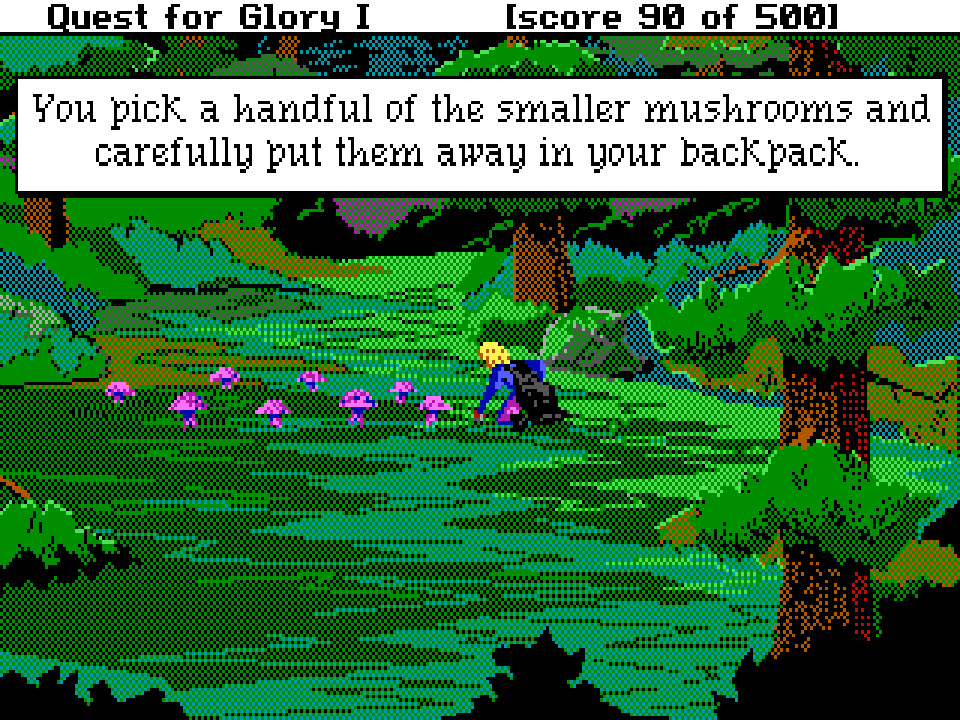
For some reason, I had images of Quest for Glory 1
in my head when I wrote this.

But even with all that, could I do it?  Let me just say I'd like to believe it would be worth doing.

I realize I'm hypocritical.  What I want is all of the best of a back-to-nature / individualistic / self-sufficient lifestyle without all of the struggle that comes along with it.  I want some modern conveniences while shirking many of the annoyances and frustrations that accompany and even enable them.  But so what? Aren't these impossibilities the foundations of fantasies?


Saturday, February 21, 2015

Impressions of Live. Die. Repeat : Edge of Tomorrow

The other night I watched Edge of Tomorrow on HBO on demand, starring Emily Blunt and Tom Cruise.  It took me a second to find it because now the movie is basically called Live. Die. Repeat : Edge of Tomorrow.  Apparently Warner Brothers had second thoughts about the original title, which is admittedly rather soft.  The source material is a Japanese light novel (think novella++) entitled All You Need is Kill.  So, in this jumble of names, I happen to like the one they finally settled on, Live. Die. Repeat.  It matches the tone of the movie.  

The overarching premise is familiar: aliens invade Earth and attempt to conquer us.  Why?  There are hints that they may be after resources, but the viewer is quickly assured that it doesn't matter why they are here, we really don't care, and we just gotta kill 'em.  Cool.  The main battle scene is well done, portrayed not so subtly as a futuristic D-Day invasion (the film WAS released on June 6, after all!).  The real hook of the movie, though, is the time loop that William Cage (Tom Cruise) is caught in.  You see, each time he dies in battle, he reawakens again the morning before with all his memories and experiences intact.  

After a number of failures/deaths, he meets up with famed soldier Rita Vrataski (Emily Blunt, who got pretty ripped for the role), and they start to work together to defeat the enemy, over and over and over again.  But, trust me, it's not boring.  Through their constant trial, error, blood, sweat, and deaths you get a sense of just how difficult the fight really is.  It's also entertaining to watch Cage interact with essentially the same set of circumstances as he becomes more and more battle hardened.  Adding to the intensity and intrigue is the fact that the movie somewhat keeps you guessing each day whether Cage and Vrataski have "made it this far before" and how much they actually know about each other.  

I do have more to say about the movie, which you can read about below if you want some spoilers, but overall, you should see it.  Then let me know what you thought. 

**WARNING: Minor spoilers below**

The alien "Mimics" are in some scenes seemingly invincible, taking round after round of machine-gun fire, while in others they are quite easily dispatched with two blasts of a shotgun or a blunt (pun!, pun!) item.  And, at times, the Mimic horde seems all but invincible, which makes you wonder why they weren't able to take over the whole earth in the first day.

Some of the early scenes, i.e. the recruitment video and the barracks scene, are cheesy and a bit reminiscent of Starship Troopers, which had me worried.

The romance aspect between Cage and Vrataski is low key, but ultimately satisfying given her rough persona.

**WARNING: Major Spoilers below**

Once Cage is given a blood transfusion and loses the ability to "restart" if he dies, the intensity level goes up a number of notches.  Somehow, because the consequences of death in the first two-thirds of the movie are so minimal, the suspense in the last third, when he can't just repeat and try again, is doubled.

In the end, when Cage dies and bathes in the blood of the Omega, the alien mastermind, he is able to loop back one final time; except this time he seems to have some kind of control over where he goes back to and what aspects of the pre-loop reality he wants to keep.  This is contrary to all his other experiences and is a bit of a plot-hole.  But, because they wanted a fairly happy ending, I guess things had to be tinkered with a bit there at the last.

Watch this movie!


Sunday, February 15, 2015

Art of Psychedelics


Psychedelics like LSD and magic mushrooms (psilocybin) go into the brain and scramble (or descramble) whatever it is in there that keeps us rooted in the plane of everyday reality.  Some say they provide a doorway to a heightened level of cosmic awareness, an understanding of our place in the universe, of our inner selves, and of the order of things.  The effects of these drugs, are intriguing at the least.  Here are some links that provide some insight:    

Drawing from 1950s LSD study

  • In the 1950s controlled research was done with LSD, and one study involving an artist under the influence of the drug produced some rather striking before-and-after style drawings.
  • Take a look here at some more interesting psychedelic related art and patterns.
  • Finally a woman draws self-portraits during an LSD trip.


I modeled the drug Trax in my novella renatus after LSD, though Trax is much meaner, and addictive to boot.

Friday, February 6, 2015

Yes, Register Your Copyright


The instant you create a work of fiction in the U.S. you own the copyright. You can reproduce it, sell it, or give it away for nothing if you want. Feel free to let everyone know, too. In fact, it's encouraged. Put that little symbol on every page if you want.

(c) 2099 Yours Truly

Try it; it's empowering.

That work will be your copyright and that of your heirs for 70 years after your death. Great, right? Nothing to worry about.

Well, not exactly. Consider this: Your novel sells well, you make money, you quit your day job and dive headlong into your new full-time writing career, bolstered in your choice by your recent success. And then some crazy starts selling your work as his own. (Why, you ask? I don't know. He's crazy. It could happen!). Time to sue him.

The thing is, though, you can't bring an infringement lawsuit unless you have registered with the Copyright Office.  Plus, let's be honest, wouldn't you like to walk into court with a nice official document printed on really official paper that says that you are, in fact, the copyright holder, slam it down on the dais and walk out in abject triumph? And wouldn't it be nice if such a document and the official registration that went along with it were only $35?  Happy you. It is. Right here: http://copyright.gov/eco/

This is what the gub'ment has to say about officially registering your copyright:
Registration is recommended for a number of reasons. Many choose to register their works because they wish to have the facts of their copyright on the public record and have a certificate of registration. Registered works may be eligible for statutory damages and attorney's fees in successful litigation. Finally, if registration occurs within 5 years of publication, it is considered prima facie evidence in a court of law. 
. . . 
In general, registration is voluntary. Copyright exists from the moment the work is created. You will have to register, however, if you wish to bring a lawsuit for infringement of a U.S. work. 
I registered my novella (see the proof in the pic?) with no problem at all-other than a few months waiting on the gears of bureaucracy-and I'm going to register my novel when it's ready to go. You should,
too.  

Wednesday, February 4, 2015

Hello World


cout << "Hello World";

Oh, C++ . . . the times we had!

For some reason, probably because I was as much of a bizarre child as I am adult, I started programming when I was about 10 years old.  Basic was first.  Then came C.  Then I moved on to C++, which I never actually got a grip on until I was older (the whole OOP thing and all).  Anyhow, I remember opening the C++ box, a big, dictionary-shaped thing with about ten 3.5 inch floppies and a few manuals, and being quite elated.  Again, I can't explain it; I had no idea what I would be programming . . . or why . . . or how.  But the possibilities were endless, it seemed to me.

So I carried on through a multi-hour install, squashing each disk as its turn came into the face of my off-white suitcase-sized 386 computer.  No telling what I ended up doing with it once it installed.  That was much too long ago.  But I think I learned a few things, regardless.  So, in honor of all that, I say, "Hello World."