Saturday, February 28, 2015

Going Hermit


I have this fantasy of going Henry David Thoreau.  Now, he died at 44 from complications due to Tuberculosis, so I don't mean I want to go fully H.D.T. - just partially.  I mean that I want to live in the woods in a tiny house watching a light rain drip from the leaves overhead.  I want to walk along paths that are overgrowing with bright green moss.  I want look out and see dragonflies skimming the surface of a deep teal pond.

And I don't want any noise.  No television.  No damn phone.  No cars or sirens or people (except my wife, of course, though she would probably only be able to handle such a lifestyle for a day.)   In essence, I/we would be hermits.  I would take a Bible, a stack of sci-fi books, and a laptop, and I would fade into the shaded corners of the forest.  I would read and write all day, from which somehow, some way I would gain my income.  

Most of the luxuries, and many of the so-called comforts of life, are not only not indispensable, but positive hindrances to the elevation of mankind.  
- Thoreau 

So could I really do it?  Well, I couldn't unless my wife came with me, or at least came home to me out there every night.  I would probably need the internet, and I would definitely need groceries and electricity and running water and plumbing.  And I'd like some whiskey.  And I wouldn't want to be too far from civilization in case something catastrophic happened to me.
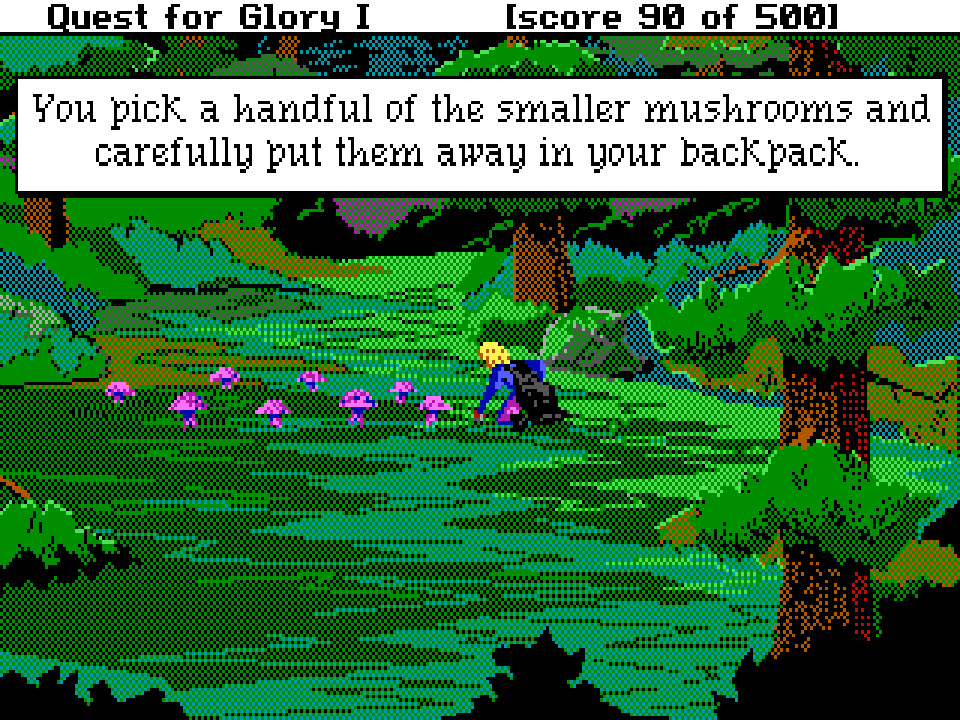
For some reason, I had images of Quest for Glory 1
in my head when I wrote this.

But even with all that, could I do it?  Let me just say I'd like to believe it would be worth doing.

I realize I'm hypocritical.  What I want is all of the best of a back-to-nature / individualistic / self-sufficient lifestyle without all of the struggle that comes along with it.  I want some modern conveniences while shirking many of the annoyances and frustrations that accompany and even enable them.  But so what? Aren't these impossibilities the foundations of fantasies?


Saturday, February 21, 2015

Impressions of Live. Die. Repeat : Edge of Tomorrow

The other night I watched Edge of Tomorrow on HBO on demand, starring Emily Blunt and Tom Cruise.  It took me a second to find it because now the movie is basically called Live. Die. Repeat : Edge of Tomorrow.  Apparently Warner Brothers had second thoughts about the original title, which is admittedly rather soft.  The source material is a Japanese light novel (think novella++) entitled All You Need is Kill.  So, in this jumble of names, I happen to like the one they finally settled on, Live. Die. Repeat.  It matches the tone of the movie.  

The overarching premise is familiar: aliens invade Earth and attempt to conquer us.  Why?  There are hints that they may be after resources, but the viewer is quickly assured that it doesn't matter why they are here, we really don't care, and we just gotta kill 'em.  Cool.  The main battle scene is well done, portrayed not so subtly as a futuristic D-Day invasion (the film WAS released on June 6, after all!).  The real hook of the movie, though, is the time loop that William Cage (Tom Cruise) is caught in.  You see, each time he dies in battle, he reawakens again the morning before with all his memories and experiences intact.  

After a number of failures/deaths, he meets up with famed soldier Rita Vrataski (Emily Blunt, who got pretty ripped for the role), and they start to work together to defeat the enemy, over and over and over again.  But, trust me, it's not boring.  Through their constant trial, error, blood, sweat, and deaths you get a sense of just how difficult the fight really is.  It's also entertaining to watch Cage interact with essentially the same set of circumstances as he becomes more and more battle hardened.  Adding to the intensity and intrigue is the fact that the movie somewhat keeps you guessing each day whether Cage and Vrataski have "made it this far before" and how much they actually know about each other.  

I do have more to say about the movie, which you can read about below if you want some spoilers, but overall, you should see it.  Then let me know what you thought. 

**WARNING: Minor spoilers below**

The alien "Mimics" are in some scenes seemingly invincible, taking round after round of machine-gun fire, while in others they are quite easily dispatched with two blasts of a shotgun or a blunt (pun!, pun!) item.  And, at times, the Mimic horde seems all but invincible, which makes you wonder why they weren't able to take over the whole earth in the first day.

Some of the early scenes, i.e. the recruitment video and the barracks scene, are cheesy and a bit reminiscent of Starship Troopers, which had me worried.

The romance aspect between Cage and Vrataski is low key, but ultimately satisfying given her rough persona.

**WARNING: Major Spoilers below**

Once Cage is given a blood transfusion and loses the ability to "restart" if he dies, the intensity level goes up a number of notches.  Somehow, because the consequences of death in the first two-thirds of the movie are so minimal, the suspense in the last third, when he can't just repeat and try again, is doubled.

In the end, when Cage dies and bathes in the blood of the Omega, the alien mastermind, he is able to loop back one final time; except this time he seems to have some kind of control over where he goes back to and what aspects of the pre-loop reality he wants to keep.  This is contrary to all his other experiences and is a bit of a plot-hole.  But, because they wanted a fairly happy ending, I guess things had to be tinkered with a bit there at the last.

Watch this movie!


Sunday, February 15, 2015

Art of Psychedelics


Psychedelics like LSD and magic mushrooms (psilocybin) go into the brain and scramble (or descramble) whatever it is in there that keeps us rooted in the plane of everyday reality.  Some say they provide a doorway to a heightened level of cosmic awareness, an understanding of our place in the universe, of our inner selves, and of the order of things.  The effects of these drugs, are intriguing at the least.  Here are some links that provide some insight:    

Drawing from 1950s LSD study

  • In the 1950s controlled research was done with LSD, and one study involving an artist under the influence of the drug produced some rather striking before-and-after style drawings.
  • Take a look here at some more interesting psychedelic related art and patterns.
  • Finally a woman draws self-portraits during an LSD trip.


I modeled the drug Trax in my novella renatus after LSD, though Trax is much meaner, and addictive to boot.

Friday, February 6, 2015

Yes, Register Your Copyright


The instant you create a work of fiction in the U.S. you own the copyright. You can reproduce it, sell it, or give it away for nothing if you want. Feel free to let everyone know, too. In fact, it's encouraged. Put that little symbol on every page if you want.

(c) 2099 Yours Truly

Try it; it's empowering.

That work will be your copyright and that of your heirs for 70 years after your death. Great, right? Nothing to worry about.

Well, not exactly. Consider this: Your novel sells well, you make money, you quit your day job and dive headlong into your new full-time writing career, bolstered in your choice by your recent success. And then some crazy starts selling your work as his own. (Why, you ask? I don't know. He's crazy. It could happen!). Time to sue him.

The thing is, though, you can't bring an infringement lawsuit unless you have registered with the Copyright Office.  Plus, let's be honest, wouldn't you like to walk into court with a nice official document printed on really official paper that says that you are, in fact, the copyright holder, slam it down on the dais and walk out in abject triumph? And wouldn't it be nice if such a document and the official registration that went along with it were only $35?  Happy you. It is. Right here: http://copyright.gov/eco/

This is what the gub'ment has to say about officially registering your copyright:
Registration is recommended for a number of reasons. Many choose to register their works because they wish to have the facts of their copyright on the public record and have a certificate of registration. Registered works may be eligible for statutory damages and attorney's fees in successful litigation. Finally, if registration occurs within 5 years of publication, it is considered prima facie evidence in a court of law. 
. . . 
In general, registration is voluntary. Copyright exists from the moment the work is created. You will have to register, however, if you wish to bring a lawsuit for infringement of a U.S. work. 
I registered my novella (see the proof in the pic?) with no problem at all-other than a few months waiting on the gears of bureaucracy-and I'm going to register my novel when it's ready to go. You should,
too.  

Wednesday, February 4, 2015

Hello World


cout << "Hello World";

Oh, C++ . . . the times we had!

For some reason, probably because I was as much of a bizarre child as I am adult, I started programming when I was about 10 years old.  Basic was first.  Then came C.  Then I moved on to C++, which I never actually got a grip on until I was older (the whole OOP thing and all).  Anyhow, I remember opening the C++ box, a big, dictionary-shaped thing with about ten 3.5 inch floppies and a few manuals, and being quite elated.  Again, I can't explain it; I had no idea what I would be programming . . . or why . . . or how.  But the possibilities were endless, it seemed to me.

So I carried on through a multi-hour install, squashing each disk as its turn came into the face of my off-white suitcase-sized 386 computer.  No telling what I ended up doing with it once it installed.  That was much too long ago.  But I think I learned a few things, regardless.  So, in honor of all that, I say, "Hello World."